From Noticeboard to Online Form: A Short History of Public Consultation
Public consultation formats shape who can respond and how. Learn what noticeboards, meetings, mail, and online forms make easier or harder.
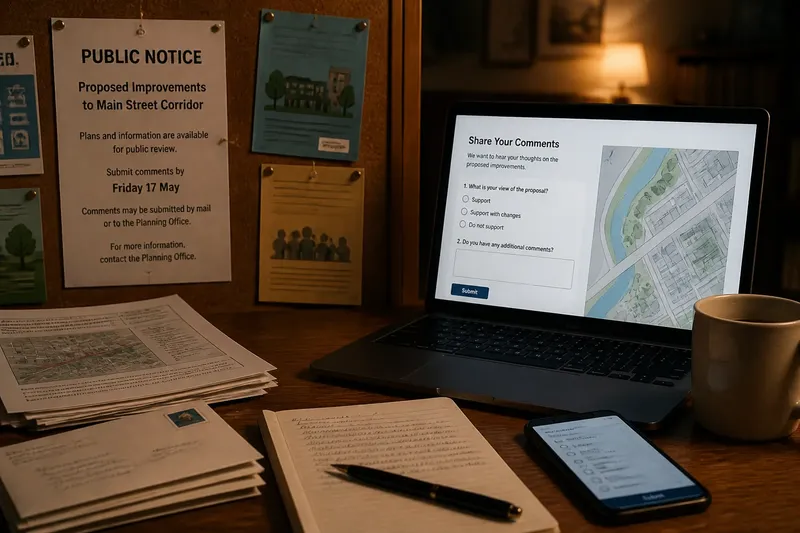
A public consultation can begin with a paper notice pinned outside a library or with a link to an online form. Public consultation formats shape who sees an invitation, what they can say, and whether officials can use the response. The change from noticeboard to digital portal has widened some routes while leaving others harder to reach.
What did a noticeboard make possible?
A noticeboard made a proposal visible in a place people already visited: a town hall, library, school, or neighborhood center. The notice could give the subject, a deadline, and directions for sending comments by letter or speaking to an official.
Its reach depended on location and timing. Someone who passed the board might learn about a road change; a person who rarely visited that building might never see the invitation. The notice also offered little room to explain a complicated proposal, so readers had to seek out a fuller document or ask staff for one.
For a reader, check whether the notice identifies the decision being considered, the response deadline, and a contact who can provide the underlying materials. A poster that says “Have your say” without those details is an invitation with no clear route forward.
How did public meetings change the exchange?
A meeting added a live conversation to the written notice. Residents could ask what a proposal meant, hear other concerns, and address officials directly; officials could clarify a term or describe how comments would be used.
But a room and a fixed hour set their own entry conditions. Work schedules, caregiving, transport, disability access, language, or discomfort with speaking in public can make attendance difficult. A meeting may also favor people prepared to speak briefly at a microphone over people who need time to organize a written response.
When a meeting is offered, look for ways to contribute without taking the floor, such as submitting a written comment beforehand or asking for an accessible format. A transcript or summary can help people who could not attend see what questions were raised.
What did mail and paper submissions add?
Paper comment forms and mailed letters gave people a response route that did not require a live appearance. A form could guide readers through specific questions, while a letter allowed them to raise an issue the form had not anticipated.
These routes still ask for time, materials, and a reliable way to send the response. A long technical document may be difficult to obtain or understand, and a form that allows only short answers can squeeze out context. Mail also tends to separate a comment from the discussion others may be having at the same time.
Imagine a resident who wants to object to a proposed bus stop relocation because the marked alternative leaves a steep walk from a nearby apartment building. A short paper form may let them register opposition, while a letter can explain the route concern and name the location. The useful format is the one that gives the resident a clear way to attach that explanation and get it to the office handling the proposal.
What does an online form make easier or harder?
An online form can gather answers in a consistent structure and let someone respond outside a meeting room’s opening hours. It can link directly to maps, draft rules, or supporting documents, and can offer a receipt so a respondent knows the submission went through.
That convenience depends on access and design. A person may lack a stable internet connection, a suitable device, confidence with the form, or the ability to use its layout with assistive technology. A portal can also discourage useful comments if it demands account creation, buries the deadline, or limits each answer to a narrow text box.
Before submitting, check that the form names the proposal, explains how to answer, and says what happens after the deadline. Save a copy of the response if the portal allows it, especially when the issue is complex.
Which questions help compare consultation formats?
Can I respond without attending in person?
Look for a mail, phone, online, or accessible in-person option, and check whether each reaches the same decision-making office. If the invitation lists only a public meeting, contact the named office to ask whether it accepts written comments by another route.
Can I explain a concern the form does not anticipate?
Check whether there is an open comment field or an option to attach a letter. A set of fixed choices may make responses easier to count, but it can leave a specific local concern unrecorded.
Will I know that my response was received?
A submission receipt or a stated contact point gives you a way to confirm delivery. If neither is available, note how and when you sent the comment so you can make a focused inquiry before the closing date.
Can I see how comments will be used?
Look for an explanation of who reviews submissions and whether the public will be able to see a summary or response. A consultation invitation should make clear whether comments can change the proposal or are being gathered for another purpose.
What should a reader look for across formats?
Formats are not a simple march from paper to better participation. A notice can alert people where they gather; a meeting can support immediate questions; a letter can hold detail; and an online form can organize responses. Each makes a different part of participation easier, while potentially putting a different burden on the person responding.
When you encounter a consultation, check the proposal itself, who is being asked, the available response routes, the deadline, and what the agency says it will do with comments. If a key detail is missing, ask the responsible office for it rather than guessing what the invitation means.
Public consultation formats matter most at the point where a person decides whether a response is worth the effort. A clear route, a comprehensible question, and room to explain a real concern can make participation more usable, whether the invitation is pinned to a board or opened on a phone.